3. Aluminium: a k-point convergence study
Before trusting any production number, a DFT practitioner checks that it is converged with respect to the sampling parameters. This tutorial runs the most common such check — total energy against the k-point mesh — as a single prompt, and shows how LatticeMind turns the study’s three numbers into a conclusion.
Metals like aluminium are the demanding case: their partially filled bands make the total energy converge slowly with Brillouin-zone sampling, which is exactly why this check matters.
What you need
The same setup as Silicon: SCF, band structure & DOS. The three SCF runs complete in about three minutes altogether.
3.1. The prompt
Another of the shipped /examples prompts:
Set up a k-point convergence study for fcc aluminum comparing 6x6x6, 8x8x8,
and 10x10x10 meshes at fixed geometry.
3.2. What LatticeMind does
Plans three SCF instances of the same fcc aluminium cell, identical in every respect except
kpoint.gridn. The validator confirms the three decks really do differ only in the mesh — a sweep that accidentally collapses to one value is refused, not run.Runs the three calculations and extracts each total energy.
Recognises the sweep in post-processing: several SCF steps whose decks differ in one sampling knob are a convergence study, so the reporter plots the energy against the configurations and leads with that figure.
3.3. The results
Mesh |
Total energy (Ha) |
ΔE to finest (meV) |
|---|---|---|
6×6×6 |
−2.076958 |
−35.11 |
8×8×8 |
−2.075994 |
−8.89 |
10×10×10 |
−2.075667 |
0 (reference) |
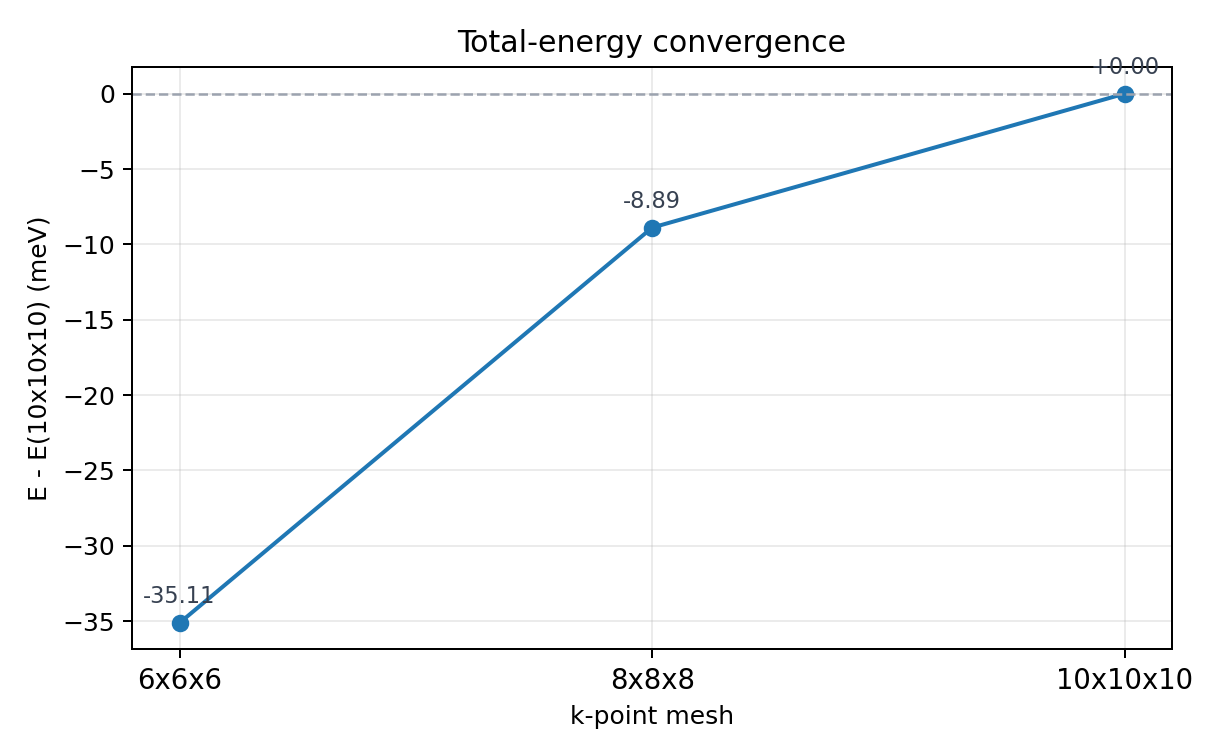
Fig. 3.3.1 Total-energy convergence of fcc Al. Each point is annotated with its distance to the finest mesh in meV; the dashed line is the 10×10×10 reference.
Reading the curve: refining from 6³ to 8³ moves the energy by ~26 meV, but the last refinement to 10³ changes it by under 9 meV. If your target accuracy is ~10 meV, the 8×8×8 mesh is the economical choice; for tighter work you would extend the series — “add a 12x12x12 mesh to the study” — and LatticeMind adds the fourth point to the same curve.
The same numbers are recorded machine-readably in the project’s
analysis_summary.json under convergence_study, with each
configuration’s energy and its delta to the finest run — ready for scripts or
notebooks that consume the study programmatically.
3.4. What you learned
A convergence study is one prompt, and its conclusion is a figure, not three disconnected numbers.
The sweep is validated as a sweep: three identical decks with different labels would be refused before anything runs.
The study extends naturally — ask for another mesh and the curve grows.
The same pattern applies to other sampling knobs: a real-space resolution
(domain.lowres) sweep is recognised and plotted the same way.