4. Ferromagnetic nickel: a two-step spin DOS
This tutorial shows two things at once: how LatticeMind handles a metal with collinear spin polarization, and how it chains a two-step workflow where a DOS run reuses the converged density of a prior SCF run.
4.1. The prompt
Create a two-step workflow for fcc nickel: first an SCF calculation, then a
DOS calculation using the saved density. Use PBE and collinear spin, set an
initial magnetic moment, and keep the calculation small but physically
reasonable for a metal.
4.2. What LatticeMind does
Builds the fcc nickel primitive cell (one atom, lattice constant 3.52 Å).
Turns on collinear spin and seeds an initial magnetic moment on the nickel atom.
Uses a metal-appropriate Brillouin-zone sampling (the tetrahedron method with Blöchl corrections) on a
12×12×12k-grid.Runs the SCF, then a DOS step that reads the saved SCF density.
The spin- and metal-specific settings show up in the generated SCF deck:
atom.magmom = [0.6];
element(1).species = 'Ni';
functional.list = {'XC_GGA_X_PBE' 'XC_GGA_C_PBE'};
spin.type = 'collinear';
kpoint.gridn = [12 12 12];
kpoint.sampling = 'tetrahedron+blochl';
Notice spin.type = 'collinear', the initial atom.magmom, and the
tetrahedron sampling — all chosen by LatticeMind because you asked for a
spin-polarized metal.
4.3. The result
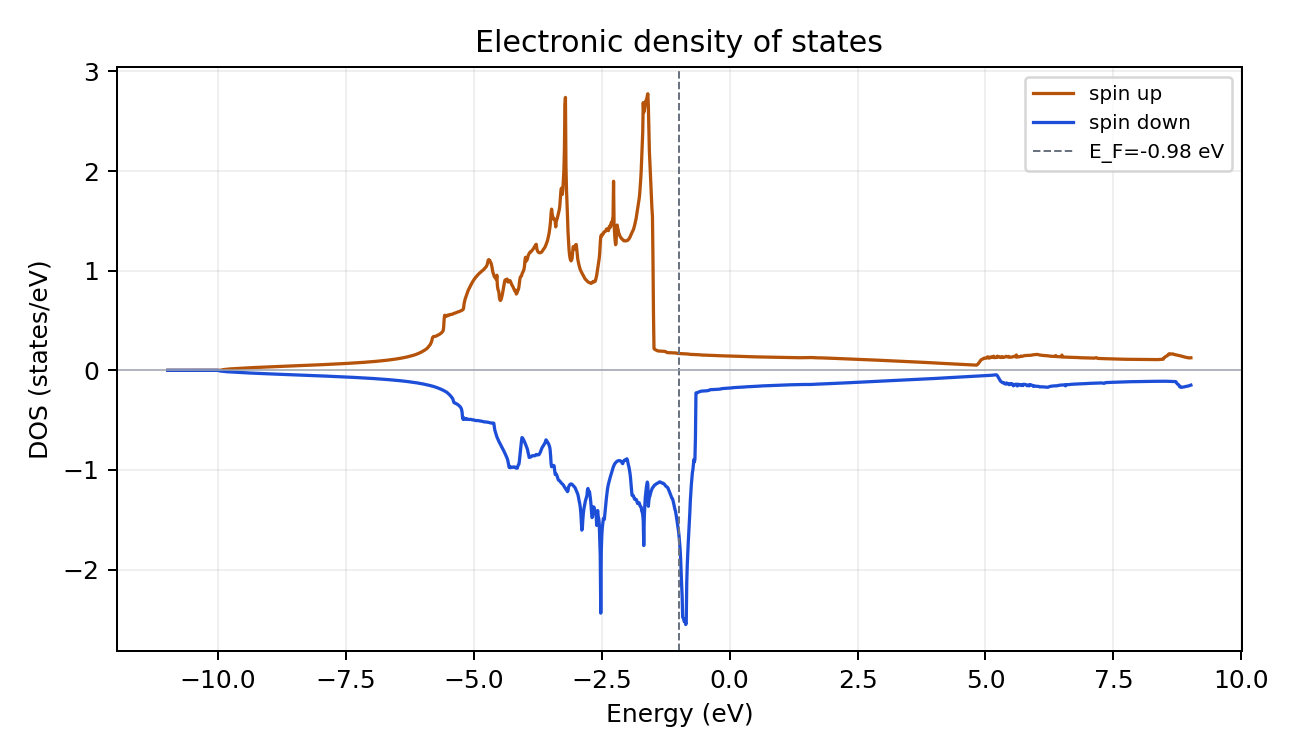
Fig. 4.3.1 Spin-resolved density of states of ferromagnetic nickel. The spin-up (majority) channel is plotted upward and spin-down (minority) downward. The exchange-split d-band and the imbalance of states at the Fermi level are the fingerprints of itinerant ferromagnetism.
The majority d-band is almost filled while the minority d-band still has weight at the Fermi level — the origin of nickel’s magnetic moment. This is exactly the physics you expect, produced from a one-paragraph prompt.
4.4. What you learned
LatticeMind recognizes metals and magnetism and adjusts sampling and spin settings accordingly.
A two-step workflow (SCF → DOS) reuses the converged density automatically — you asked for it in words, and the hand-off was wired for you.
Next: build an alloy in Building alloys & supercells (SiGe).