3. Remote & HPC execution
LatticeMind builds inputs locally and can offload the actual calculation to a remote workstation or a Slurm HPC cluster. It sends a self-contained job bundle — inputs, scripts, pseudopotentials (and, for NanoDCAL, the basis files), a manifest, and a generated job script — runs it over SSH, and fetches the verified results back.
Important
LatticeMind never sends your API key and never runs the AI agent remotely. Only the solver job is executed on the remote host. It also never stores your password, private key, or 2FA code.
3.1. Overview
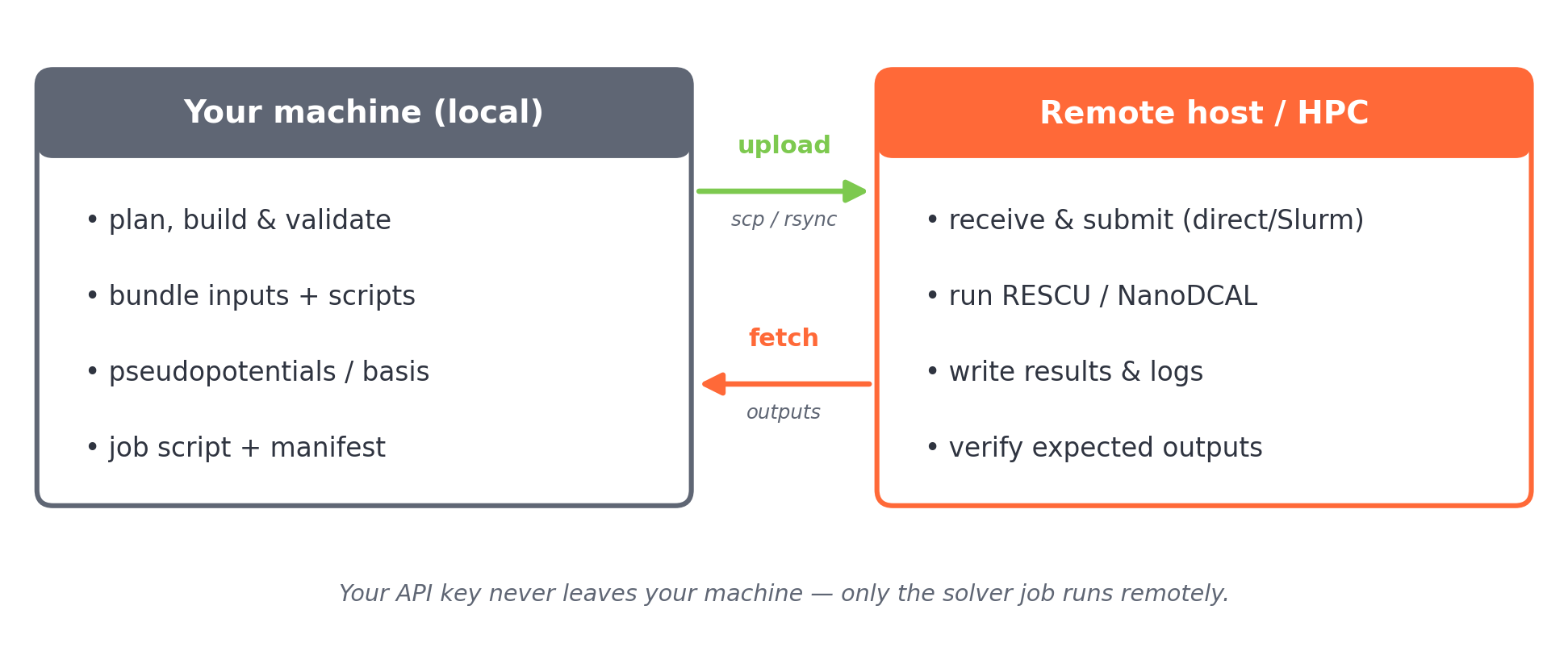
Fig. 3.1.1 Remote execution: LatticeMind bundles the validated job locally, uploads it, submits it (directly or via Slurm), then fetches the verified outputs back into the project.
3.2. Step 1 — Confirm plain SSH works
Before involving LatticeMind, make sure ordinary SSH already connects to your machine or cluster:
ssh my-profile true
LatticeMind drives ssh, scp/rsync, and Slurm commands through your
normal SSH configuration. Fix any SSH issues here first.
3.3. Step 2 — Describe the target
Define one or more profiles in ~/.latticemind/remote_profiles.toml.
Direct SSH workstation:
[profiles.office]
host = "my-office-computer"
scheduler = "direct"
remote_root = "/home/myuser/latticemind_runs"
transfer = "scp"
rescu_command = "rescu"
shell_preamble = ""
Slurm cluster:
[profiles.cluster]
host = "my-cluster-login"
scheduler = "slurm"
remote_root = "/scratch/myuser/latticemind_runs"
transfer = "rsync"
rescu_command = "rescu"
shell_preamble = "module load rescu"
account = "my-account"
partition = "short"
time = "02:00:00"
nodes = 1
ntasks = 4
cpus_per_task = 1
mem = "8G"
Field |
Meaning |
|---|---|
|
SSH host (as in your |
|
|
|
Base directory on the remote host where job bundles are staged. |
|
|
|
The RESCU launch command on the remote host. For NanoDCAL use
|
|
Shell lines run before the solver, e.g. |
|
Slurm resource request for |
3.4. Step 3 — Select and test the profile
From inside LatticeMind:
/remote profiles            # list profiles
/remote profile office      # select one
/remote setup office        # add reusable-SSH settings (helps with 2FA)
/remote warm office         # open one approved SSH session (approve 2FA once)
/remote test office         # check SSH, solver, and scheduler
/compute remote             # or: /compute slurm
/execute on
A convenient shortcut runs the whole selection interactively:
/remote wizard
Tip
If your machine uses 2FA, /remote warm lets you approve it once;
LatticeMind reuses that single approved SSH session for upload, submit,
status, logs, and fetch.
You can also run remote commands from the shell before opening the app:
latticemind remote setup office
latticemind remote warm office
latticemind remote status office
latticemind remote close office   # close the saved SSH session early
3.5. Step 4 — Launch and track jobs
Before any remote run, LatticeMind shows the exact target, remote directory, upload method, job script, inputs, and Slurm resources for you to review. After submitting, track the job for the active project:
/remote status
/remote logs 80
/remote fetch
/remote fetch latest
/remote workdir
/remote cancel
/remote doctor      # remote/HPC readiness checks
From the shell, the profile is named on the command line, and a long calculation can be released so that it keeps running after LatticeMind exits:
latticemind run "<request>" --execute --approve-execution \
    --remote-profile cluster --detach
latticemind run --project <project-dir> "Continue this project: collect the finished results" \
    --execute --approve-execution --remote-profile cluster
The released wave runs under nohup (direct SSH targets) or as the submitted
batch job (Slurm), independent of the SSH session that started it. The second
command reattaches through the project’s execution lease, fetches what has
finished, and reports from it. See Releasing a long calculation.
3.6. Serial-only guardrails
Some RESCU post-analysis stages must run serially. LatticeMind parses each input
before launch and, for guarded stages such as dfpt-phonon-bs,
dfpt-phonon-dos, dfpt-optic, and dfpt-raman, removes MPI launchers
and unsafe parallel flags. For Slurm bundles containing only guarded serial
stages, it also submits with one node, one task, and one CPU per task. Override
the guarded list with LATTICEMIND_RESCU_SERIAL_ONLY_CALC_TYPES only if your
RESCU build supports those stages in parallel.
3.7. Runtime profiles (deployment context)
Remote profiles describe how jobs launch. Runtime profiles describe the broader shell/cloud environment and advisory operator instructions LatticeMind should consider when planning run scripts and reports. Set them interactively:
/runtime
/runtime cloud on
/runtime system Linux container with RESCU 3.x under /opt/esapp
/runtime note Slurm jobs must use /scratch/myuser and module load rescu
/runtime prompt Use the shared scratch filesystem for generated job files.
/runtime file /home/myuser/latticemind_operator_prompt.txt
/runtime save
Or via environment variables in cloud deployments:
export LATTICEMIND_CLOUD_MODE=1
export LATTICEMIND_RUNTIME_PROFILE=cluster
export LATTICEMIND_SYSTEM_DESCRIPTION="Linux container with RESCU under /opt/esapp"
export LATTICEMIND_ENVIRONMENT_NOTES="Use /scratch/myuser; module load rescu before jobs"
export LATTICEMIND_OPERATOR_PROMPT_FILE=/home/myuser/latticemind_operator_prompt.txt
export LATTICEMIND_EXECUTION_BACKEND=slurm
export LATTICEMIND_REMOTE_PROFILE=cluster
export LATTICEMIND_REMOTE_SCHEDULER=slurm
Or persist them in ~/.latticemind/config.json (or a file named by
LATTICEMIND_CONFIG_FILE):
{
  "runtime_profile": {
    "runtime_profile_name": "cluster",
    "cloud_mode": true,
    "system_description": "Linux container with RESCU installed under /opt/esapp",
    "environment_notes": "Use /scratch/myuser; module load rescu before jobs",
    "operator_instructions": "Use the shared scratch filesystem for generated job files.",
    "execution_backend": "slurm",
    "remote_profile": "cluster",
    "remote_scheduler": "slurm",
    "rescu_command": "/opt/esapp/rescu"
  }
}
Note
Operator instructions are advisory deployment context. They do not
enable or disable solver execution. Use /execute on or /execute off
for interactive work; agent commands require both --execute and
--approve-execution before a solver may launch.
See also
A full worked example — recovering an interrupted silicon DFPT phonon run on a remote cluster — is in Running on an HPC cluster.