3. Reproducing a published figure: two-dimensional altermagnets
An altermagnet has no net magnetization, like an antiferromagnet, yet its bands are spin-split in parts of the Brillouin zone, like a ferromagnet. Sødequist and Olsen [1] predict four such monolayers, RuF4, OsF4, VF4 and AgF2. Their Fig. 1 shows the signature: in the Néel state the two spin channels coincide along Γ–X–S–Y–Γ and split along the diagonal Γ–S.
This tutorial reproduces that figure with VASP in one research conversation: LatticeMind reads the paper, sets up and runs an SCF and a band structure for each material, checks each result, and draws the four panels.
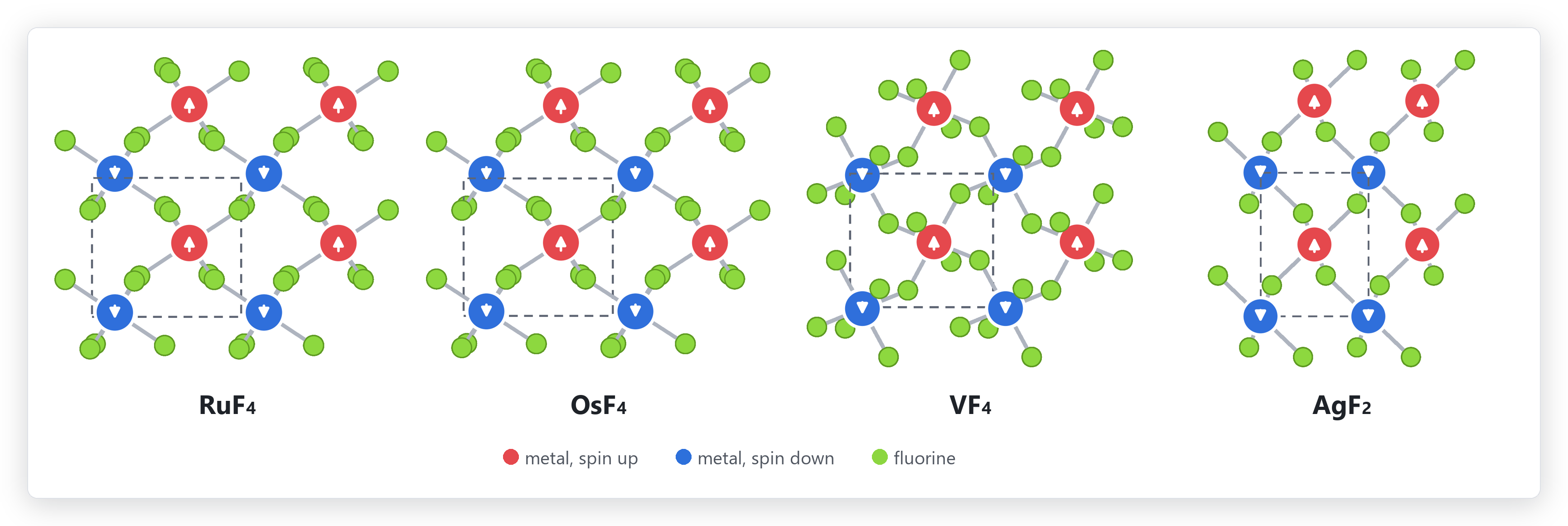
Fig. 3.1 The four monolayers seen from above, with the rectangular cell dashed. The two metal atoms of each cell carry opposite moments; the fluorine atoms carry none.
3.1. Before you start
VASP set up as in VASP calculation types (preview), with the PBE PAW potentials Ru_pv, Os_pv, V_sv, Ag and F.
The paper’s PDF in the project folder, so LatticeMind can attach and read it.
The four monolayer structures, for example from the C2DB database, centred in a cell with about 20 Å of vacuum.
3.2. The request
Start latticemind or latticemind-web in the folder and describe the
calculation. The request below is shortened; the full request also named the
files and a few more INCAR tags.
I want to reproduce Figure 1 of Sødequist and Olsen, Appl. Phys. Lett. 124,
182409 (2024): the band structures without spin-orbit coupling of RuF4, OsF4,
VF4 and AgF2 along Γ–X–S–Y–Γ–S, with the two spin channels coloured. Attach
and read the Figure 1 caption and the computational details first. The paper
used GPAW (PAW, 800 eV, PBE, no U) on the Néel state; stay as close to that as
VASP allows.

For each material, one collinear spin-polarized SCF and one band structure
reading its charge density: the PBE potentials Ru_pv, Os_pv, V_sv, Ag and F;
ENCUT = 800 eV, PREC = Accurate, EDIFF = 1E-7, a Γ-centred 12 × 12 × 1 mesh;
opposite moments on the two metal atoms and none on fluorine, mapped to the
atom order in the POSCAR you write; the band path Γ–X–S–Y–Γ–S with 16 points
per segment.

Run the calculations one at a time and check each before the next: the SCF
must converge and the two metal moments must be equal and opposite. If one
does not, stop and tell me; do not change the functional or add U to force a
result.
3.3. What LatticeMind does
Attaches the paper and reads the caption and the computational details.
Creates a VASP project, checks that each requested potential exists, and reads the four structures.
Declares an SCF and a band structure for each material. The band run reads its parent’s charge density (
ICHARG = 11) and repeats the parent’s settings, and the initial moments are placed on the two metal atoms as the rendered POSCAR orders them.Asks before each launch, runs one calculation at a time, and reads each run’s evidence before the next: electronic convergence, the per-ion moments, the band gap along the path and where the spin splitting is largest.
Ends with one table for the four materials.
The settings, next to the paper’s:
Paper (GPAW) |
This tutorial (VASP) |
|
|---|---|---|
Method |
PAW, plane waves, PBE, no U, no SOC |
PAW, plane waves, PBE, no U, no SOC |
Cutoff |
800 eV |
800 eV, |
Magnetic state |
Néel (spin-compensated) |
|
SCF |
not stated |
Γ-centred 12 × 12 × 1, |
Bands |
Γ–X–S–Y–Γ–S |
Γ–X–S–Y–Γ–S, 16 points per segment, |
All four SCFs converged, and the metal moments came out equal and opposite with zero net moment: the Néel state the paper describes.
3.4. The figure
A second message asks for the figure in the paper’s style: one row of four panels, the energy zero in the middle of the gap, the paper’s energy ranges, spin up red and spin down blue, grey wherever the two channels agree within 2 meV. LatticeMind writes one plotting script for all four materials, shows it for approval, and draws the figure from the band runs’ own output.
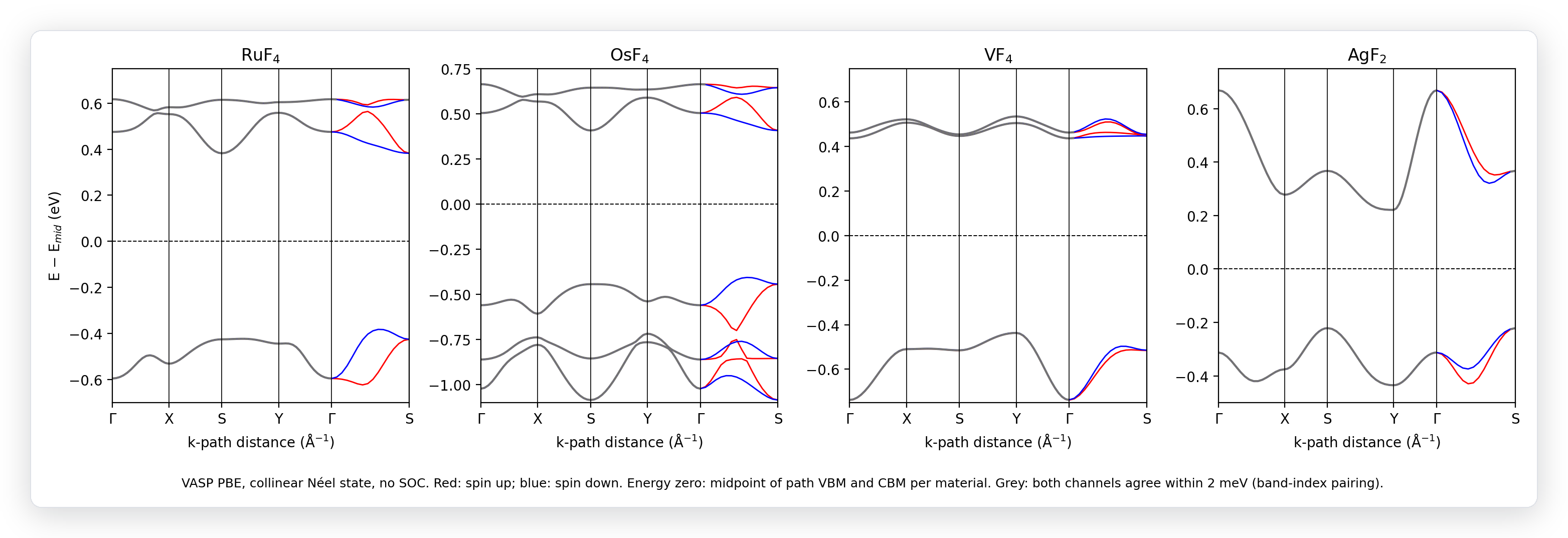
Fig. 3.4.1 LatticeMind’s reproduction of Fig. 1. The channels coincide (grey) along Γ–X–S–Y–Γ and split into red and blue along Γ–S, the altermagnetic signature.
The reproduction matches the published Fig. 1 panel for panel: the shape and ordering of the bands, the degenerate edges and the size of the splitting on Γ–S. A final request in the same conversation repeated RuF4 at 600 eV on an 8 × 8 × 1 mesh; no band moved by more than 0.3 meV, so the production settings are converged for these bands.
3.5. Tips
Name the atoms that carry the moments. Ask for the moments by element (“opposite moments on the two metal atoms”) and to map them to the POSCAR order. Structure files often list the atoms in a different order from the POSCAR that VASP reads.
Memory. At 800 eV each SCF needed about 9 GB on 8 MPI ranks with
KPAR = 1; a largerKPARmultiplies that. On a laptop, run one calculation at a time.Time. On 8 ranks of a laptop, each 10-atom SCF took 35 to 40 minutes and its band structure about 14; the 6-atom AgF2 took 15 minutes in all. Running on a remote machine or cluster sends the same runs to a cluster.
Keep asking in the same conversation. The figure was drawn from the finished runs, and the convergence check joined the same project, so nothing was set up twice.